How to Scale Food Production from Concept to Market in Lebanon
By Anthony Abi Nader, Food Technology Consultant at Umami Plus. Anthony has taken food products from formulation through pilot scale-up, factory commissioning, and HACCP and quality systems. Last updated: October 2026.
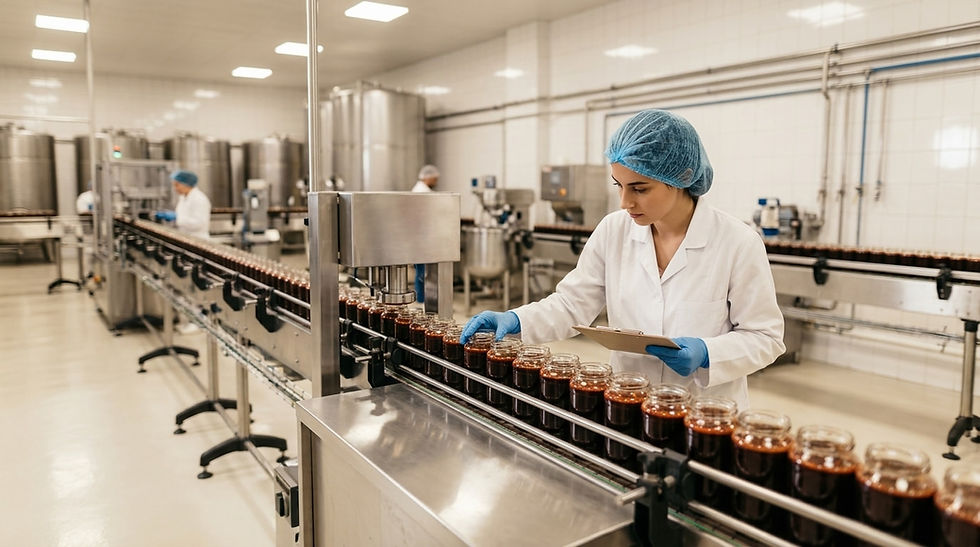
The short answer: To scale food production in Lebanon, validate the concept, develop and stabilise the formulation, prove its safety and shelf life, run pilot trials, secure industrial and health licensing, design packaging and labels, choose between your own plant and a co-packer, then launch in stages with tight cost and quality control. Skipping the technical steps between the kitchen and the factory is the most common reason products fail.
Why it is hard to scale food production in Lebanon
A recipe that works for 5 kg rarely works the same way at 5,000 kg. Heat transfer, mixing, hold times, ingredient variability, and equipment limits all change at scale, and so do taste, texture, and stability. In Lebanon, you also have to deal with imported ingredients and packaging, high operating costs, and a competitive local market. This is why learning how to scale food production in Lebanon means working through a technical and regulatory process, not just making a bigger batch.
Step 1: Define the product and test the market
Before spending on development, write a clear product brief: target consumer, price point, format, shelf life, storage conditions (ambient, chilled, frozen), and the markets you want to reach (local retail, food service, export). Test demand with a small sample group. A strong brief saves months of rework, because every later decision, from ingredients to packaging, depends on it.
Step 2: Develop and optimise the formulation
Formulation turns your idea into a repeatable recipe. The goal is to hit your target on taste, texture, nutrition, stability, and cost at the same time. Ingredient selection matters here: pick ingredients you can source consistently in Lebanon or import reliably, and avoid relying on a single supplier for a critical component. Document every trial so the recipe can be reproduced exactly.
Step 3: Validate safety, quality, and shelf life
This is the step many young brands skip, and it is where products fail. Validation includes microbiological safety, stability testing, sensory evaluation, and shelf-life studies under realistic storage conditions. Identify the hazards specific to your product. For instance, low-moisture products like tahini carry a known Salmonella risk that has to be controlled through process design, not just final testing. Shelf-stable versions of fresh products, such as canned hummus, need preservation strategies that protect safety without losing the traditional taste.
For lab testing, the Lebanese Agricultural Research Institute (LARI) operates a laboratory used for food product testing.
Step 4: Pilot trials and process scale-up
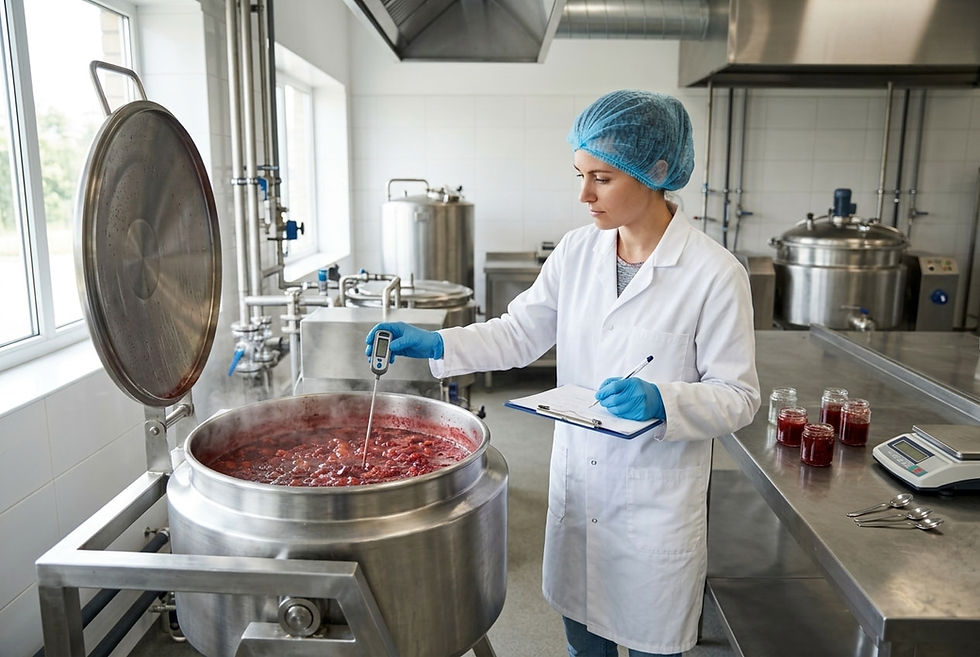
Run pilot batches on production-scale or near-production-scale equipment before committing to a full launch. Pilot trials reveal problems the lab can't: ingredient behaviour in large mixers, heat penetration in bigger containers, filling-line issues, and yield losses. Use them to set critical process parameters (time, temperature, pH, fill weight) and to calculate your true cost per unit. Adjust the formulation and process together, because a recipe change often needs a matching process change.
Step 5: Licensing and regulatory compliance in Lebanon
Several authorities are involved, and the sequence matters.
Ministry of Industry: Industrial establishments need a licence. Under Decree No. 8018 of 2002, applications go to the Licensing and Control Department at the Regional Industry Department, and the Ministry of Industry issues the final decision.
Ministry of Public Health (MoPH): Its Food Safety Department monitors food production, processing, and distribution facilities and enforces food safety rules and Good Manufacturing Practices.
LIBNOR (Lebanese Standards Institution): National standards are voluntary in principle, but can become mandatory by decree for reasons of public health, safety, or national interest. LIBNOR also authorises the Lebanese Conformity Mark. Check whether a mandatory standard applies to your product category.
Customs and the Ministry of Economy and Trade: These matter for importing ingredients and packaging, and for consumer protection and labelling compliance.
Don't treat licensing as optional. In an MoPH inspection of pickle factories, only 59% of the inspected factories held an operating licence from the Ministry of Industry.
Unlicensed production exposes you to closures, blocks access to retailers, and rules out export.
Step 6: Packaging and labelling
Packaging is part of the product's safety and shelf life, not just its branding. It must suit the process (hot-fill, retort, aseptic, modified atmosphere), protect against oxygen, light, and moisture, and be compatible with the food. Labels need to meet Lebanese requirements and, for export, the rules of the destination market. Confirm the current labelling requirements with the authorities before printing.
Step 7: Decide how you will manufacture
You have three main options:
Build your own facility. This gives you control but needs significant capital, a licence, and technical staff.
Use a co-packer. This lowers the upfront investment and lets you test the market, but you depend on their capacity, quality systems, and schedule.
Hybrid approach. Start with a co-packer, then move in-house once volume justifies it.
Whichever you choose, define your quality specifications and approval criteria in writing.
Step 8: Build a food safety and quality system
As volume grows, informal checks stop being enough. Put in place GMP, a HACCP plan, supplier approval, raw material specifications, in-process controls, traceability, and a recall procedure. If you want to supply supermarkets, large distributors, or export markets, buyers will often expect recognised certification, such as ISO 22000 or FSSC 22000, so plan for it early.
Step 9: Launch in stages
Start with a limited launch: a few channels, a controlled geography, and a manageable volume. Track repeat purchases, complaints, shelf-life performance, and margins. Then expand to wider retail, food service, or export. Early distribution data tells you whether your forecast, pricing, and production capacity are realistic.
Step 10: Keep optimising
After launch, keep reducing cost and variability: renegotiate suppliers, tune the process, improve yield, and reformulate where needed, without changing what customers love about the product.
Common mistakes to avoid
Scaling before shelf life and safety are validated
Ignoring the real cost per unit until after launch
Depending on one supplier for a critical ingredient or packaging item
Starting production before licences are in place
Treating the lab recipe as the final production recipe
Underestimating working capital for ingredients, packaging, and distributor payment terms
Frequently asked questions
How long does it take to take a food product to market in Lebanon?
It depends on product complexity, shelf-life requirements, and licensing. A simple product can be developed in a few months, while shelf-stable, chilled, or functional products need longer validation. Licensing timelines vary, so start them in parallel with development.
Do I need a licence to produce food commercially in Lebanon?
Yes. Industrial establishments are licensed through the Ministry of Industry, and food facilities are also subject to Ministry of Public Health inspection.
Can I start with a co-packer?
Yes, and many brands do. It lowers upfront cost, but you must still control the specifications and quality of the finished product.
What is the biggest technical risk when scaling?
Moving from lab to production without proper pilot trials and validation. This is where taste, texture, stability, and food safety problems usually appear.
Can I export Lebanese food products?
Yes, but each destination has its own rules for labelling, additives, certification, and testing. Build those requirements into your formulation and packaging from the start, not after production.
How Umami Plus can help
Umami Plus supports food businesses from idea to commercial production, covering R&D, formulation, food technology, food safety and quality, and scale-up. With more than 25 years of food R&D experience across Lebanon, Africa, and the MENA region, the team has worked on projects such as shelf-stable hummus, tahini safety optimisation, ready-to-eat Lebanese dishes, instant functional beverages, and the commissioning of food manufacturing facilities.
Have a product idea? Start a project with Umami Plus.
Comments