How to Validate a New Food Product Idea in Lebanon: A 6-Step Framework
By Anthony Abi Nader, Food Technology Consultant at Umami Plus. He has led food product development and factory start-ups across Lebanon. Last updated: October 2026.
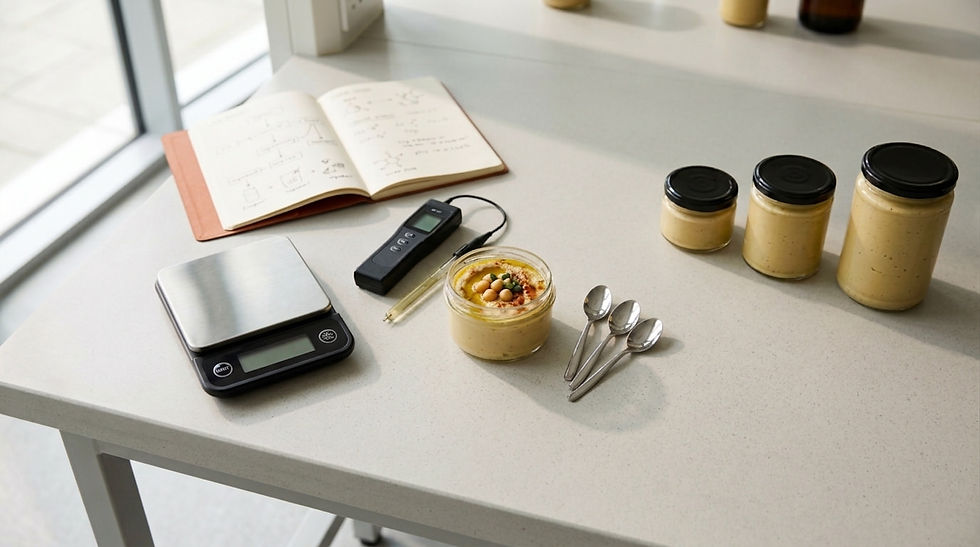
The short answer
To validate a new food product idea in Lebanon, test six things before you invest in packaging, equipment or inventory: consumer demand, technical feasibility, shelf life and food safety, regulatory compliance, unit economics, and channel access. A food idea can fail on any one of these, even when customers love the concept. The goal of validation is to find out cheaply and early which of the six is your weak point, and to fix it or walk away before real money is spent.
Why food validation is different from other businesses
Most advice on validating a business idea focuses on one question: will people buy it? For food, that is only the first of several. A product has to taste the same in batch 500 as in batch 1, stay safe and appealing for its entire shelf life, comply with labeling and registration rules, and still leave a margin after the distributor and the retailer take their share.
In our experience in food R&D across Lebanon, Africa and the wider MENA region, the most common reason promising food ideas stall is not weak demand. It is a problem that could have been discovered in the first few weeks: a recipe that works in a home kitchen but not at scale, a product that spoils before it reaches the shelf, or costs that only make sense at a volume the founder cannot yet afford.
The 6 steps at a glance
Step | Question it answers | Typical method | Rough time |
1. Demand | Will people buy this, and at what price? | Small-batch test, pre-orders, store pilot | 2 to 6 weeks |
2. Technical feasibility | Can it be made consistently and at scale? | Bench prototype, pilot batch | 4 to 12 weeks |
3. Shelf life and safety | Does it stay safe and good until it is consumed? | 4 weeks to several months | |
4. Regulatory | Can I legally make, label and sell it? | Check licensing, registration and labeling rules | 2 to 8 weeks, in parallel |
5. Unit economics | Do I make money per unit? | Cost-of-goods model, margin stack | 1 to 3 weeks |
6. Channels | Who will stock it and how do I reach them? | Retailer, HoReCa, online and export conversations | Ongoing |
Timelines are indicative and vary widely by product category. A simple dry mix is far quicker to validate than a ready-to-eat shelf-stable meal.
Step 1: Validate consumer demand
What you are testing: whether a specific group of people has a real need for this product and will pay your intended price.
How to do it in Lebanon:
Define one target consumer first. "Everyone who likes hummus" is not a target. "Working households who want authentic Lebanese dishes without cooking time" is.
Run a small-batch test. Produce a limited quantity and sell it, rather than giving it away. Free samples tell you whether people are polite. Sales tell you whether they are customers.
Use the channels Lebanese consumers already use. Instagram, WhatsApp groups and word of mouth let you take pre-orders at almost no cost.
Try a pop-up, local market or a single-store pilot. A specialty shop or a small supermarket chain will often agree to a limited trial, and you learn how the product behaves on a real shelf.
Test price, not just taste. Offer two price points to different groups and watch what happens.
Red flags: only friends and family are buying; people like it but do not reorder; the price that makes your numbers work is well above what testers say they would pay.
Step 2: Validate technical feasibility
What you are testing: whether the product can be made the same way every time, with available ingredients and realistic equipment.
A recipe that works in a kitchen is a starting point, not a product. Before committing to production, check:
Bench-scale versus pilot-scale behavior. Texture, viscosity, color and flavor can change when volumes grow or heating and cooling times change.
Ingredient availability and consistency. Can you source the same quality year-round, and what happens if a supplier changes or an imported ingredient is delayed?
Process limits. What equipment does it truly need, and can a co-packer or contract manufacturer do it?
Reproducibility. Make the product at least three times, ideally on different days, and compare results objectively, not just by eye.
This is where a food technologist adds the most value. Converting a traditional Lebanese dish into a convenient format, for example, is a formulation and process challenge as much as a culinary one. The goal is to keep the taste identity people expect while meeting the demands of processing, packaging and storage.
Red flags: results vary from batch to batch; the product only works with a specialized ingredient you cannot reliably get; the process needs equipment far beyond your budget.

Step 3: Validate shelf life and food safety
What you are testing: whether the product stays safe, and still tastes and looks right, from production until the consumer finishes it.
This step is the one most often skipped, and the one that causes the most expensive failures. Key points:
Shelf life must be tested, not guessed. Use stability studies that track appearance, flavor, texture and microbiological safety over time. Accelerated testing can give early indications, but it does not replace real-time data.
Know your product's risk profile. Factors such as water activity, pH, preservation method and storage temperature determine which microorganisms matter and which controls you need. A low-moisture product, an acidic sauce and a ready-to-eat meal are all very different.
Packaging is part of the formula. Barrier properties, filling temperature and sealing quality directly affect shelf life.
Plan for local conditions. Lebanon's summer heat and variable cold-chain reliability mean your product should be tested under realistic storage and transport conditions, not only ideal ones.
Build food safety in from the start. A basic HACCP-based approach identifies critical control points early. Some customers, especially large retailers and export buyers, will ask for certifications such as ISO 22000 or similar.
Red flags: nobody has measured water activity or pH; the shelf life on your label is an estimate; you have not tested the product after storage in realistic conditions.
Step 4: Validate regulatory compliance
What you are testing: whether you can legally produce, label and sell the product, and in which markets.
Requirements depend on the product category, whether you produce at home or in a licensed facility, and whether you sell locally or export. Typically you will need to look into:
Facility licensing and permits for the place where the food is made, which usually involves the Ministry of Industry and the Ministry of Public Health, depending on your setup.
Product registration and laboratory analysis requirements for the category you are in.
Labeling rules, including language, ingredient and allergen declaration, nutritional information, dates and storage instructions, aligned with Lebanese standards (LIBNOR) and consumer protection requirements.
Export-market rules. Gulf, African and European markets each have their own labeling, certification and shelf-life requirements, and these should be considered at the formulation stage, not after production.
Important: Regulations and administrative procedures in Lebanon change. Always confirm the current requirements directly with the relevant ministries and standards bodies, or with a consultant who works with them regularly, before you finalize your plan.
Red flags: you plan to sell before knowing which permits apply; your label has not been checked; you intend to export without checking the destination market's rules.
Step 5: Validate your unit economics
What you are testing: whether you make a profit on each unit sold, after all real costs and after every party in the chain takes their margin.
Work backward from the shelf price:
Start with the retail shelf price consumers will accept.
Subtract the retailer margin, then the distributor margin, if you use one.
What remains is your ex-factory price.
Compare it with your full cost of goods: ingredients, packaging, labor, energy, waste, lab testing, transport and overheads.
An illustrative example (numbers are for demonstration only):
Shelf price: 5.00 USD
Retailer margin 25%: 1.25 USD, leaving 3.75 USD
Distributor margin 15%: about 0.56 USD, leaving about 3.19 USD ex-factory
Full cost of production: 2.80 USD
Profit before marketing and financing: about 0.39 USD per unit, or roughly 12% of the ex-factory price
A product that looks profitable on a spreadsheet can quickly become a loss once you include waste, returns, and small-batch inefficiencies.
Lebanon-specific factors to build into your model:
Many packaging materials and some ingredients are imported, so prices and lead times can shift.
Energy and logistics costs can be significant and unpredictable.
Minimum order quantities for packaging can lock up cash well before your first sale.
Pricing in a largely dollarized market affects both costs and what consumers will pay.
Red flags: your margin only works at a volume you have not yet proven you can sell; you have not included waste, testing and packaging minimums; your price is set by cost alone rather than by what the market accepts.
Step 6: Validate your channels
What you are testing: who will actually stock, buy or distribute the product, and on what terms.
Retail (supermarkets and specialty stores): Ask buyers what they need to list a new product: price points, shelf life, barcodes, margins, listing fees and payment terms.
HoReCa (hotels, restaurants, cafes): Often a good early channel for products that save kitchen time or provide consistency.
Online and social selling: Useful for testing and for building a direct customer base.
Export and diaspora markets: Lebanese food has strong recognition abroad. Check the importing country's requirements and the shelf life needed for shipping.
Co-packing and private label: Sometimes the right route is to supply other brands rather than build your own.
Talk to buyers early. A distributor's honest reaction to your product and price is among the most valuable validation data you can get.
Red flags: no buyer has seen the product; you assume distribution will "sort itself out"; the terms buyers offer do not fit your cash flow.
The Lebanon factor: opportunities and constraints
Opportunities
A strong culinary identity and a recognized food culture, at home and abroad.
A large diaspora and established regional trade relationships.
Growing interest in convenience, health and functional foods, such as high-protein products, ready-to-eat traditional dishes and instant beverages.
Traditional foods such as hummus, tahini, molasses and grain-based dishes that can be reformulated into shelf-stable, convenient formats.
Constraints
Cost and reliability of energy and logistics.
Dependence on imported packaging and some ingredients.
Limited access to financing for small producers.
Variability in cold-chain infrastructure.
A good validation plan treats these as design inputs, not afterthoughts.
Common mistakes to avoid
Treating friends' feedback as market proof. Polite praise is not demand.
Scaling before testing shelf life. Discovering a spoilage problem after production is far more expensive than finding it at the prototype stage.
Ignoring cost at industrial scale. A recipe's cost at 5 kg is not its cost at 500 kg.
Leaving regulation and labeling until the end. They can force reformulation or repackaging.
Validating only the idea, not the process. A great concept with an unrepeatable process is not a product.
Skipping professional input. A few weeks with a food technologist often saves months and a significant amount of money.
A simple go / no-go scorecard
Before committing money to production, score each area from 1 (not tested) to 5 (clearly proven):
Area | Score (1 to 5) | Evidence |
Consumer demand | ||
Technical feasibility and repeatability | ||
Shelf life and food safety | ||
Regulatory and labeling readiness | ||
Unit economics | ||
Channel access |
How to read it: if every area scores 4 or higher, you are ready to move to scale-up. If any area scores 2 or below, fix that area first, because one weak link can sink the whole project. A score of 1 means the area is unproven, which is a risk, not a failure.
From validation to production
Validation is the stage between a promising idea and an expensive commitment. Once the six areas are proven, the next steps are formulation optimization, scale-up trials, process definition and commercial production. At Umami Plus, we support this entire journey, from initial concept and formulation to scale-up and commercial manufacturing, with a focus on products that are safe, scalable, cost-conscious and commercially viable.
Frequently asked questions
How can I validate a food product idea in Lebanon?
Test six areas: consumer demand, technical feasibility, shelf life and food safety, regulatory compliance, unit economics and channel access. Start with a small, low-cost batch, sell rather than give away samples, and confirm shelf life and costs before investing in production.
How much does it cost to test a food product idea in Lebanon?
It depends on the product category and how far you go. A simple small-batch demand test can be very inexpensive, while shelf-life testing, laboratory analysis and pilot trials add costs that vary by product. The most useful approach is to budget the validation stages separately and spend in order: demand first, then feasibility, then shelf life, so that you stop early if a stage fails.
Can I make food at home and sell it in Lebanon?
Small-scale home production is common for early testing, but selling food commercially generally involves licensing, hygiene and labeling requirements, and these differ by product type and scale. Check the current rules with the relevant authorities before selling, especially for products that need controlled processes such as canned, low-acid or ready-to-eat items.
How long does it take to develop and validate a new food product?
Simple products can be validated in a few months. Products with demanding shelf-life requirements, such as shelf-stable ready-to-eat meals, or those aimed at export markets, usually take longer because stability testing needs time.
Do I need a food technologist to start?
Not for the very first demand test, but you will need one as soon as you consider scale, shelf life or safety. Involving a food technologist early typically prevents costly reformulation and delays.
What licenses do I need to launch a food product in Lebanon?
This depends on your product, your facility and your target markets, and may involve several ministries and standards requirements. Because procedures change, confirm the latest requirements directly with the relevant authorities or with a consultant who handles them regularly.
What is the biggest reason new food products fail?
Common causes are unproven shelf life, costs that do not work at scale, and relying on enthusiasm from friends instead of real purchasing behavior. All three can be tested early.
Have a food product idea?
Umami Plus helps food businesses in Lebanon and the region develop, formulate, validate and scale products. If you have an idea and want to know whether it is ready for production, tell us about your project or explore our food product development services.


Comments