What Are the Steps to Commercialize a Food Product in Lebanon? An 8-Step Guide
By Anthony Abi Nader, Food Technology Consultant at Umami Plus. Anthony has taken food products from formulation to factory commissioning, HACCP and quality systems. Last updated: October 2026.
The short answer
To commercialize a food product in Lebanon, you move through eight steps: (1) freeze the product and its specifications, (2) confirm shelf life and food safety, (3) choose your production route, (4) secure licenses and registrations, (5) finalize packaging, labeling and barcodes, (6) set pricing and arrange financing, (7) run pilot production under a quality system, and (8) launch through your chosen sales channels. Some steps can run in parallel, but skipping any of them is what usually turns a promising product into an expensive problem.
What "commercializing" actually means
Commercialization is everything between a validated idea and a product that is sold repeatedly, legally and profitably. If validation answers "should I do this?", commercialization answers "how do I do this properly?". It covers the product itself, the place and process that make it, the paperwork that allows you to sell it, the package that protects and presents it, and the route that gets it to customers.
If you have not yet tested demand, feasibility and costs, start with our guide on validating a food product idea in Lebanon. This article assumes you have a product worth taking to market.
The 8 steps at a glance
Step | Goal | Main output | Rough time |
1. Freeze the product | Lock recipe, process and specifications | Standard formulation and spec sheets | 2 to 6 weeks |
2. Shelf life and safety | Prove the product is safe and stable | Stability data, lab results, HACCP plan | 1 to 6 months |
3. Production route | Decide where and how it is made | Own facility or co-packer agreement | 2 to 8 weeks |
4. Licenses and registrations | Be legally able to produce and sell | Permits, registrations, company papers | 2 to 6 months, in parallel |
5. Packaging and labeling | Protect, comply, and sell | Final pack, compliant label, barcode | 4 to 10 weeks |
6. Pricing and financing | Make the numbers work | Price structure, budget, funding | 2 to 4 weeks |
7. Pilot production | Prove you can make it consistently | First commercial batches, quality records | 4 to 8 weeks |
8. Launch and channels | Get it on shelves and in baskets | Listings, distribution, sales | Ongoing |
Timelines are indicative only. They vary a great deal with the product category, the production route and how quickly authorities respond.
Step 1: Freeze the product and its specifications
Before anything else, turn your best prototype into a defined, repeatable product.
Fix the formulation. Write the recipe in exact weights and percentages, not "a handful" or "until it looks right".
Define the process. Record each step with times, temperatures, equipment and critical settings.
Write specifications for ingredients, packaging and the finished product: appearance, taste profile, texture, pH, water activity, microbiological limits and net weight.
Secure ingredient supply. Identify at least two suppliers for key ingredients and check their consistency and lead times.
Protect your brand. Consider trademark registration and keep your formulation documents confidential.
Any change to the recipe after this point can affect shelf life, labeling and costs, so it is much cheaper to settle it now.
Step 2: Confirm shelf life and food safety
This is the technical foundation of the whole project.
Run stability studies in the final packaging and under realistic storage conditions, tracking appearance, flavor, texture and microbiological safety over time. Accelerated tests can give early indications but should be backed by real-time data.
Analyze the product in an accredited laboratory for the parameters relevant to its category.
Build a food safety system. A HACCP-based plan identifies hazards and critical control points. Many retailers and export buyers expect HACCP or an ISO 22000 type certification.
Test under Lebanese conditions. Summer heat and variable cold-chain reliability should be part of your storage and transport assumptions.
The shelf life you print on the label should come from data, not from a guess or a competitor's label.
Step 3: Choose your production route
You have three main options, and the choice shapes your costs and timeline.
Route | Best for | Main advantages | Main risks |
Your own facility | Proven products with volume | Full control, higher margin at scale | High investment, licensing burden, fixed costs |
Co-packer or contract manufacturer | Early-stage products, testing the market | Low upfront cost, faster start | Less control, minimum quantities, recipe confidentiality |
Hybrid (co-pack first, own plant later) | Growing products | Lower risk, learn before investing | Requires technology transfer later |
For many new products, starting with a co-packer and moving to your own plant once volumes are proven is the lower-risk path. If you build your own facility, plan the layout, equipment, utilities, waste handling and hygiene design with a food technologist before buying machinery, since mistakes here are costly to correct.
Step 4: Secure licenses and registrations
This step often takes longer than expected, so start it early and run it in parallel with the technical work.
The exact requirements depend on your product, whether you manufacture yourself or use a licensed third party, and whether you sell locally or export. In practice you will deal with several of these:
Company and commercial registration for your legal entity.
Industrial licensing. In Lebanon, industrial establishments are licensed under rules set out in Decree No. 8018 of 2002. Applications go through the regional industry department, and the Ministry of Industry issues the decision.
Public health requirements. The Ministry of Public Health inspects food establishments and has acted against unlicensed ones, so health compliance for your premises and product category should be confirmed early.
Food safety law. The Food Safety Law No. 35 of 2015 involves the Ministries of Public Health, Agriculture, Industry, and Economy and Trade, and provides for a national food safety commission. How its provisions are applied in practice has evolved over time, so check the current status.
Consumer protection and labeling requirements overseen by the Ministry of Economy and Trade, together with Lebanese standards from LIBNOR.
Municipal and environmental permits for the production site.
Export requirements. The Ministry of Industry introduced licensing requirements for exporting locally manufactured food products in March 2022. Confirm whether and how this applies to your product, and check the import rules of each destination country.
Important: Lebanese regulations and procedures change, and different product categories follow different paths. Treat this section as a map of what to ask about, not as legal advice. Confirm current requirements directly with the relevant ministries or with a professional who handles these files regularly.
If you use a co-packer, check that the facility holds the licenses needed for your product category and ask to see them.
Step 5: Finalize packaging, labeling and barcodes
Packaging protects the product, communicates the brand, and is a legal document in its own right.
Choose packaging that fits the product. Barrier properties, filling temperature, closure and seal integrity directly affect shelf life, so test the final pack, not a similar one.
Mind the supply chain. Many packaging materials are imported. Check minimum order quantities and lead times, and avoid locking up cash in large orders before sales are proven.
Prepare a compliant label. This generally includes the product name, ingredient list, allergen information, net quantity, production and expiry dates, storage conditions, producer details and nutritional information as required, in the languages required. Have the label reviewed before printing.
Obtain barcodes. Retailers will expect a barcode (GTIN). These are typically obtained through GS1 Lebanon, so confirm the current procedure.
Plan batch coding and traceability so that every unit can be traced back to its production batch.
Step 6: Set pricing and arrange financing
Work backward from the shelf price, as you would in validation, but now with real costs.
Start with the shelf price the market will accept.
Subtract the retailer margin and the distributor margin.
What remains is your ex-factory price.
Compare it with your full cost of goods: ingredients, packaging, labor, energy, waste, laboratory testing, transport and overheads.
Then build the budget for the launch itself: licenses, equipment or co-packer set-up, minimum packaging orders, first raw material purchases, marketing, listing fees and working capital while customers pay you.
Financing options for small food businesses may include personal capital, partners or investors, supplier credit, and loan guarantee or support programs for SMEs such as those offered through Kafalat. Availability and terms have changed with the economic situation, so check what is currently offered.
A frequent mistake is to underestimate working capital. Retailers and distributors often pay after 30 to 90 days, while you pay for ingredients and packaging up front.
Step 7: Run pilot production under a quality system
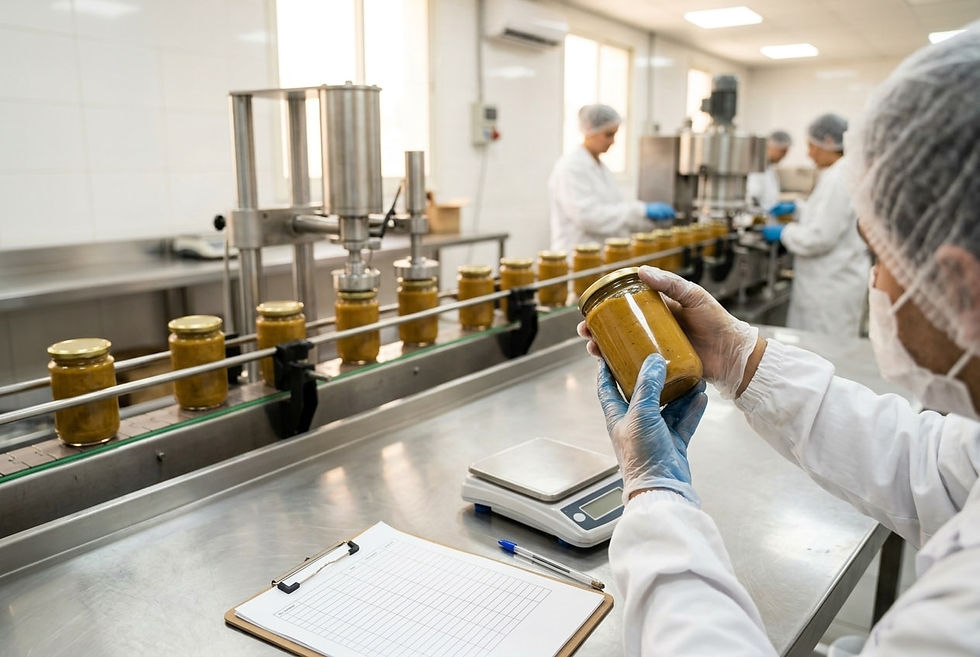
Before a full launch, produce your first commercial batches in the real facility, with real equipment and real operators.
Compare pilot results with your specifications. Check taste, texture, appearance, weight, pH, water activity and microbiology.
Document everything. Batch records, ingredient lot numbers, process parameters and test results build the evidence that buyers and inspectors ask for.
Train the team on hygiene, the process and the critical control points.
Set up a basic quality system: supplier approval, incoming material checks, calibration, cleaning and sanitation, a complaint procedure, and a recall plan.
Keep retained samples of each batch for the duration of the shelf life.
The aim is to show that you can make the same product, to the same quality, every time.
Step 8: Launch and build your channels
Choose channels that match your product, your production capacity and your cash flow.
Supermarkets and specialty stores: Prepare a short sales sheet with the product, price structure, shelf life, barcode and logistics terms. Buyers will ask about margins, listing fees, payment terms and promotions.
HoReCa (hotels, restaurants, cafes): Often a strong early channel for products that save time or give consistency.
Distributors: They give reach but take a margin and need volume, reliability and clear terms.
Online and direct sales: Useful for early revenue, customer feedback and building a brand.
Export and diaspora markets: Lebanese food has strong recognition abroad. Check the destination's labeling, certification and shelf-life requirements early, and plan for transport conditions.
After launch, monitor sell-through, complaints and returns, and keep improving. The first months give you the real information that no pre-launch test can.
Realistic timeline
A simple, low-risk product made through a co-packer can reach the market within a few months. A product with demanding shelf-life needs, its own production facility, or export ambitions typically takes considerably longer, because stability testing, licensing and equipment lead times all take time. Planning steps in parallel, especially licensing and packaging, is the best way to shorten the path.
Common mistakes to avoid
Changing the recipe late. It forces new shelf-life tests, new labels and new costs.
Treating licensing as a final formality. It can be the longest part of the project.
Printing labels or ordering packaging before approvals. Mistakes are expensive to undo.
Ordering large packaging quantities too early and tying up cash.
Underestimating working capital while waiting for customers to pay.
Skipping the pilot phase and discovering problems at full scale.
Ignoring traceability and recall planning until something goes wrong.
Choosing the production route without comparing costs and risks.
Commercialization checklist
Before your first commercial sale, confirm that you can answer "yes" to each item:
Item | Ready? |
Recipe, process and specifications are fixed and documented | |
Shelf life is supported by real stability data | |
Food safety plan (HACCP-based) is in place | |
Production route is decided and agreed | |
Required licenses and registrations are obtained or in process | |
Label has been checked for compliance | |
Barcode is assigned | |
Price structure leaves a margin at every level | |
Budget and working capital are secured | |
Pilot batches meet specifications | |
Traceability and recall procedures exist | |
At least one sales channel is confirmed |
If several answers are "no", fix those before spending on launch activities.
How Umami Plus can help
Umami Plus supports food businesses through the whole path from concept to commercial production: formulation and process definition, shelf-life and stability planning, HACCP and quality systems, factory set-up and commissioning, and scale-up. If you have a product and want to know what it takes to bring it to market, get in touch with us to discuss your project.
Frequently asked questions
What are the steps to commercialize a food product in Lebanon?
The main steps are: freeze the product and specifications, confirm shelf life and food safety, choose your production route, secure licenses and registrations, finalize packaging, labeling and barcodes, set pricing and financing, run pilot production under a quality system, and launch through your chosen channels.
How long does it take to commercialize a food product in Lebanon?
It depends on the product and route. A simple product made through a co-packer can take a few months, while products that need long shelf-life testing, their own facility or export approvals usually take longer. Running licensing, packaging and testing in parallel shortens the timeline.
How much does it cost to launch a food product in Lebanon?
Costs vary widely with the product category, the production route and the scale. The main cost blocks are product development and testing, licenses, equipment or co-packing set-up, packaging minimums, first ingredient purchases, marketing and working capital. Building a line-by-line budget early is the most reliable way to see what you really need.
Do I need my own factory to sell a food product in Lebanon?
No. Many food brands start with a licensed co-packer or contract manufacturer and move to their own facility once volumes justify it. This lowers the upfront investment and the risk.
What licenses do I need to sell food in Lebanon?
It depends on your product, your production site and your target markets. Typically it involves company registration, industrial licensing through the Ministry of Industry, public health requirements, labeling and consumer protection rules, and possibly municipal and export permits. Requirements change, so confirm them with the relevant authorities or a consultant.
Can I export a Lebanese food product?
Yes, but each destination has its own labeling, certification and shelf-life requirements, and Lebanon has its own export licensing rules for locally manufactured food products. Plan for export during formulation and packaging rather than after production.
Do I need a food technologist to commercialize a food product?
It is strongly recommended. A food technologist helps with formulation, scale-up, shelf life, HACCP and factory set-up, which are the areas where mistakes are most expensive.
Have a food product idea?
Commercializing a food product is easier with an experienced partner who has been through each step. If you have a product and want to know what it will take to bring it to market, contact Umami Plus to discuss your project, or explore our food product development and commercialization services to see how we support food businesses from formulation to commercial production.
Comments