How to Formulate Instant Electrolyte and Functional Drink Powders for Commercial Production
By Anthony Abi Nader, Food Technology Consultant at Umami Plus. Anthony has taken food products from formulation through pilot scale-up, factory commissioning, and HACCP and quality systems, including powder blends and beverage products. Last updated: October 2026.

The short answer
To formulate instant electrolyte and functional drink powders for commercial production, choose mineral and ingredient forms that dissolve fast and taste acceptable, balance acids, sweeteners and flavors to mask the salty and bitter notes of minerals, and test every ingredient pair for compatibility. Then control moisture at every step, because humidity is the root cause of caking, clumping and flavor loss. Finally, match the package to the climate and the shelf life you claim, and design the blending process so that the micro-ingredients end up evenly distributed in every sachet. A formula that passes in the lab but is made in a humid room, or packed in a weak barrier film, will fail in the market.
Why electrolyte and functional powders are harder than they look
An instant drink powder is a dry mixture of many ingredients with very different particle sizes, densities and affinities for water. Mineral salts, acids and sweeteners are often hygroscopic, flavors can be fragile, and functional actives such as vitamins, amino acids or caffeine can be bitter, poorly soluble or sensitive to moisture and oxygen. All of this has to dissolve in a glass of water in seconds, taste good, and stay free-flowing for 12 months or more in a hot, humid supply chain.
1. Solubility
Consumers judge an instant powder in the first 15 seconds. It should wet quickly, sink or disperse without floating clumps, and dissolve without sediment or haze.
Choose soluble ingredient forms. Citrates, chlorides and gluconates of sodium and potassium dissolve readily. Some magnesium and calcium sources (oxides and carbonates, for example) dissolve poorly and leave sediment, while magnesium citrate, malate or glycinate are more soluble but differ in taste and cost.
Mind particle size. Very fine powders can float and form lumps on contact with water. Coarser or agglomerated particles wet and sink faster. Balance this against segregation risk (see section 7).
Improve wettability. Agglomeration or granulation, and where permitted, lecithin coating of fat- or protein-containing powders, improve dispersibility.
Check amino acids and other actives. BCAAs and some other amino acids are poorly soluble in cold water and can foam. Test at the actual drinking temperature and volume.
Test the real use case. Dissolve the powder in cold, room-temperature and hard tap water at the label dose, and score time to dissolve, sediment and clarity.
2. Flavor
Minerals taste bad. Sodium gives salty notes, potassium chloride adds bitterness and a metallic aftertaste, magnesium is bitter, and calcium can be chalky. The sweetener and flavor system has to cover all of this.
Balance the acid system. Citric, malic and tartaric acid shape the sourness and help mask salty and bitter notes. Test blends rather than a single acid.
Blend sweeteners. Sucralose, acesulfame K, stevia glycosides or sugar and dextrose each have different sweetness curves and aftertastes. Blends give a more rounded profile. If you want a glucose-sodium (hydration) positioning, dextrose may be a functional choice, not just a sweetener.
Choose flavors that suit the base. Citrus, berry, tropical, watermelon and mint profiles mask minerals well, while subtle flavors do not. Local options such as lemon-mint, orange blossom or pomegranate can differentiate.
Use the right flavor format. Spray-dried flavors suit powders, but they are hygroscopic and can lose intensity if moisture gets in.
Manage actives. Caffeine, creatine, B vitamins and herbal extracts add their own bitterness, color and smell, which may need targeted masking.
Test at serving strength. Taste at the intended dilution and temperature, preferably chilled, with consumers from your target market.
3. Ingredient compatibility
Powders look inert, but ingredients interact through moisture, pH and trace metals.
Ingredient or pair | Typical issue | How to manage |
Citric acid with bicarbonate or carbonates | Reacts with moisture and releases gas (fizzing), which swells packs and destroys the powder | Keep effervescent systems in very low humidity, use barrier packaging and separate reactive parts if needed |
Vitamin C (ascorbic acid) | Oxidizes and browns, especially with moisture, heat and metal ions | Use stable forms, control moisture and oxygen, consider overage and protective packaging |
B vitamins (for example B2, B12) | Color, light sensitivity and potency loss | Protect from light, plan overage, verify potency over shelf life |
Reducing sugars with amino acids or proteins | Maillard browning during storage | Limit reducing sugars, control moisture and temperature |
Hygroscopic salts and acids | Absorb water and trigger caking | Choose less hygroscopic forms, dry the blend and use a strong moisture barrier |
Magnesium and calcium salts | Poor solubility, chalky taste or interaction with other minerals and acids | Select soluble forms, test combined doses |
Natural colors and flavors | Fade or change with light, acid and moisture | Test stability in the finished pack |
Total dose also matters. Adding many minerals and actives per serving can create taste, solubility and regulatory limits. Check maximum levels per serving for vitamins and minerals in the markets you serve.
4. Moisture control
Moisture is the central enemy of every powder formula.
Know your critical relative humidity (CRH). Each ingredient absorbs water above a certain humidity. A blend behaves like its most sensitive component, so identify the weakest ingredients.
Set specifications. Define moisture content and water activity (many instant powders aim for a low water activity, often below about 0.3-0.4, but the right target depends on your formula) for incoming materials and the finished blend, and test every lot.
Control the production environment. Blend and fill in a room with controlled temperature and humidity. This matters especially in coastal Lebanese summers, when ambient humidity is high.
Dry and store ingredients properly. Keep hygroscopic materials sealed, reseal open bags immediately, avoid cold-to-warm condensation on ingredients taken from cold storage, and use first-in, first-out.
Avoid moisture sources. Wet cleaning residue, humid compressed air, open hoppers and slow filling all add water.
5. Caking
Caking is the most common complaint about powders: a hard block in the sachet or tub that will not pour or dissolve.
Typical causes
Moisture uptake from the air, ingredients or packaging.
Temperature cycling in trucks, warehouses and shops, which dissolves and recrystallizes surface material and fuses particles.
Amorphous (non-crystalline) ingredients such as spray-dried flavors and some sugars, which absorb water readily.
Very fine particles, which have more contact area, and compression under stacking weight.
Fine hygroscopic salts and acids on the particle surface.
Typical solutions
Reduce moisture and hygroscopic components, and use higher-melting or less hygroscopic ingredient forms where possible.
Use permitted anti-caking agents such as silicon dioxide or tricalcium phosphate at the lowest effective dose. Some agents can hinder wetting, so retest solubility after adding them.
Improve particle size distribution and consider granulation or agglomeration.
Use better barrier packaging and consider desiccants or oxygen absorbers where suitable.
Test for caking directly: store packed samples under hot, humid and temperature-cycling conditions, with weight on top, and score flowability and dissolving time over time.
Always confirm which anti-caking agents and additives are permitted, and at what levels, in Lebanon and in each export market.
6. Packaging
For powders, the pack is part of the formulation.
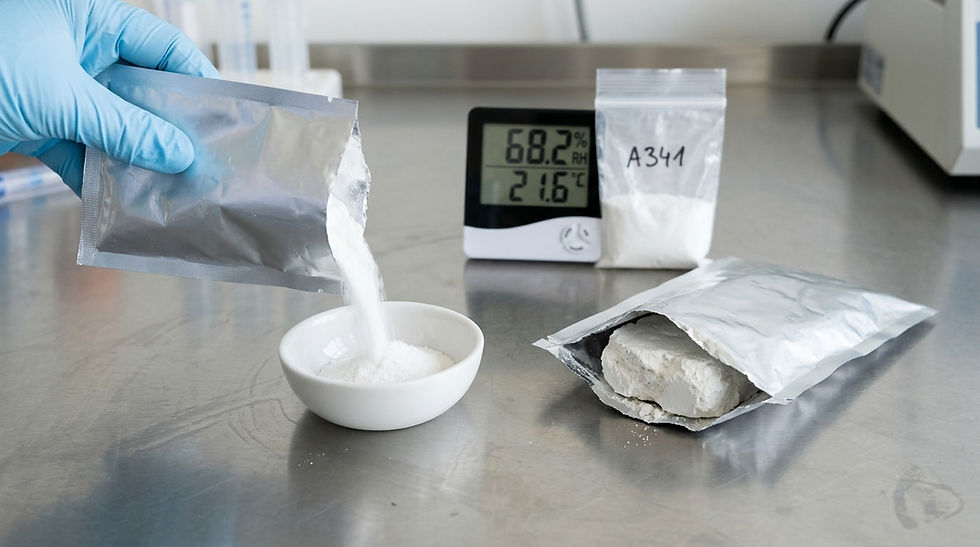
Barrier. Use laminates with a low moisture vapor transmission rate (MVTR) and oxygen transmission rate (OTR), such as metallized or aluminum foil structures. Clear films with low barrier are risky for hygroscopic or oxidation-sensitive products.
Format. Single-serve stick packs and sachets protect the product better than a tub that is opened repeatedly, while tubs and pouches need good resealing and a scoop. Choose the format with the consumer's use in mind.
Seal quality. Poor seals let humidity in. Define seal parameters, check seal strength and leak-test routinely.
Headspace and desiccants. Nitrogen flushing and desiccant sachets or canisters can extend shelf life for sensitive formulas.
Climate. Test packaging under hot, humid conditions that reflect your distribution chain, not only on a lab bench.
Shelf life. Set it from real-time and accelerated storage data for moisture, caking, dissolving time, taste, color and the stability of vitamins and other actives. Set the label date shorter than the longest stable tested period.
7. Production scale-up for electrolyte drink powders
A recipe that blends well in a kitchen mixer can fail in a factory blender. Check these points before scaling up.
Segregation. Particles with different sizes and densities separate during blending, transfer and filling, so the first and last sachets differ in composition. Match particle sizes where possible, shorten transfer steps, avoid dropping powder from height, and verify uniformity by sampling at several points.
Micro-ingredients. Vitamins, sweeteners, colors and flavors are used in small amounts and must be pre-mixed into a carrier (geometric dilution) before adding them to the main blend.
Order of addition and mixing time. Define both, and validate them. Over-mixing can cause segregation or heat the blend, and under-mixing leaves it uneven.
Equipment. Ribbon, paddle and V-blenders behave differently. Choose by batch size, powder properties and cleaning needs, and confirm fill accuracy and dust control on the filling line.
Environmental control. Maintain temperature and humidity during blending and filling, and keep open product exposure time short.
Food safety. Low-moisture products need supplier approval, incoming checks, sieving, metal detection or X-ray, and a HACCP plan that covers Salmonella risk in raw materials and cross-contamination.
Allergens and cleaning. Powder lines need validated dry-cleaning or wet-cleaning procedures, and clear allergen labelling.
Documentation. Keep batch records with all parameters and run at least three consecutive pilot batches on production-like equipment before committing to commercial volumes.
For the wider path from idea to launch, see our guide on how to scale food production from concept to market in Lebanon.
Claims, labelling and regulation
Electrolyte and functional powders sit between food, beverage and food supplement categories, and the rules depend on the classification, the nutrients and actives used, the claims made and the market. Confirm requirements with LIBNOR, the Ministry of Economy and Trade, the Ministry of Industry and the Ministry of Public Health in Lebanon, as relevant to your product, and with the regulator in each export market. Check permitted ingredients, maximum levels per serving, and wording for hydration, performance or health claims, before you finalize the formula and the label.
When to bring in external R&D or technical consulting
Many manufacturers can adjust an existing blend in house. Consider external support when:
The powder dissolves poorly, tastes salty or bitter, or leaves sediment, and you cannot find the cause.
The product cakes or clumps in storage or in the market.
You are launching a new category, such as electrolyte, hydration, energy, collagen, protein or sugar-free functional powders.
Vitamins or actives lose potency or change color during shelf life.
Batches vary in taste, color or composition between sachets or between runs.
You are moving from small-batch blending to an industrial line and need to redesign the process and packaging.
You need stability data, specifications or technical files for retailers, certification or export.
You lack equipment or lab capability for water activity, particle size, flow or accelerated storage testing.
External support is usually cheapest before you order packaging, ingredients and equipment, because most expensive mistakes are locked in at that point. Umami Plus offers food formulation, product R&D and technical consulting services for manufacturers, from the first prototype to pilot scale-up.
Project experience
Electrolyte hydration powder: improving solubility and shelf stability for a food manufacturer (anonymized)
Challenge: The manufacturer wanted to develop a low-sugar electrolyte hydration powder for single-serving sachets, providing sodium, potassium and magnesium while maintaining a refreshing citrus flavor. Initial prototypes suffered from a salty-bitter aftertaste, slow dissolution and caking during storage, affecting product quality and consumer convenience.
What we found: Initial trials showed that the powder required approximately 90–120 seconds to dissolve in 250 mL of water, with some visible sediment remaining after mixing. Moisture content ranged from 2.5–3.5%, while water activity measured approximately 0.25–0.35. Differences in particle size and hygroscopicity between mineral salts, acids and sweeteners contributed to inconsistent dispersion and localized moisture absorption. The original packaging also provided insufficient moisture protection for the intended storage conditions.
What we changed: We optimized the mineral salt system by adjusting the forms and ratios of sodium, potassium and magnesium sources, while refining the citric acid, flavor and high-intensity sweetener balance to reduce bitterness and improve citrus flavor perception. We evaluated compatible anti-caking agents, standardized ingredient particle sizes where practical, and improved the blending sequence to promote uniform distribution of low-dose ingredients. Moisture exposure during production was minimized, and the packaging specification was upgraded to a high-moisture-barrier laminate suitable for individual sachets.
Result: The optimized prototype dissolved in approximately 30–45 seconds in 250 mL of water, with substantially improved dispersion and no visible persistent sediment under the defined test conditions. Moisture content was reduced to approximately 1.5–2.0%, with water activity maintained below 0.25. No visible caking was observed during an initial 12-week accelerated stability assessment, and sensory evaluation improved from approximately 5.5/10 to 8/10 for overall flavor acceptance. Estimated ingredient and packaging costs increased by approximately 3–5% per kilogram due to the improved packaging specification and formulation adjustments. The prototype was considered suitable for further validation before commercial production, including real-time shelf-life and packaging compatibility studies.
See more of our work on the Umami Plus projects page.
Frequently asked questions
How do you stop electrolyte powder from caking?
Control moisture in the ingredients, the production room and the pack. Use less hygroscopic ingredient forms, a suitable anti-caking agent at the lowest effective level, good particle size distribution, and a high-barrier, well-sealed package. Then verify with accelerated storage and temperature-cycling tests.
How can I improve the taste of an electrolyte powder?
Balance the acid system, blend sweeteners, choose flavors that mask salty and bitter notes, and select mineral forms that taste better at the target dose. Always taste at serving strength and temperature.
Why does my drink powder not dissolve properly?
Common causes are poorly soluble mineral or amino acid sources, very fine particles that float and clump, or no wetting aid. Select soluble ingredient forms and consider agglomeration, then test in cold and hard water.
What packaging is best for instant drink powders?
High-barrier laminates (such as metallized or foil structures) with good seals protect against moisture and oxygen. Single-serve sachets and stick packs perform better than tubs that are opened repeatedly, and desiccants or nitrogen flushing can help sensitive formulas.
What is the shelf life of an electrolyte drink powder?
Many powders are labelled for around 12 to 24 months, but the right figure depends on formula, moisture, packaging and storage conditions. Set it from your own real-time and accelerated storage data.
When should I hire a food R&D consultant for a drink powder project?
Hire one when taste, solubility, caking or stability problems persist, when you are launching a new powder category, when you need to scale from small batches, or when you need documented stability data and specifications.
Talk to us about your project
If you are developing or reformulating electrolyte drink powders or functional drink mixes and are facing solubility, flavor, caking, packaging or scale-up challenges, Umami Plus provides food product R&D, formulation and technical consulting to manufacturers in Beirut, Mount Lebanon and across Lebanon.
Start a project with Umami Plus: tell us about your drink powder challenge.
Comments