How to Optimize Food Formulations for Commercial Production in Lebanon
By Anthony Abi Nader, Food Technology Consultant at Umami Plus. Anthony has taken food products from formulation through pilot scale-up, factory commissioning, and HACCP and quality systems. Last updated: October 2026.
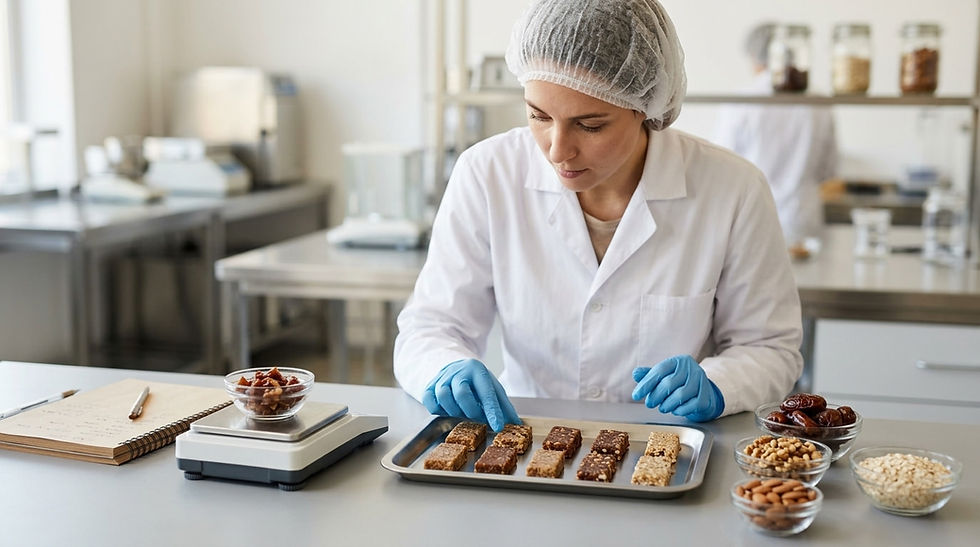
The short answer: To optimize food formulations for commercial production in Lebanon, convert the lab recipe into a weight-based master formula, identify what each ingredient does, test changes with designed experiments, adjust the recipe to your equipment and process, build in approved alternative ingredients, and confirm taste, safety, and shelf life in pilot batches before scaling up. The goal is a formula that tastes right, stays stable, runs smoothly on the production line, and hits your target cost every batch.
What does it mean to optimize food formulations for commercial production?
A formulation that works in a home kitchen or a lab is a starting point, not a finished product. To optimize food formulations for commercial production means refining the recipe so it delivers the same quality at industrial volumes, within your cost target, using ingredients and equipment you can rely on, and with a shelf life that survives distribution.
A commercial-ready formulation has to balance five things at once:
Sensory quality: taste, aroma, color, and texture that customers recognize and come back for
Safety and stability: microbiological safety, and no separation, staling, or flavor loss over the shelf life
Processability: it mixes, heats, fills, and packs without line stoppages or yield loss
Cost: a cost per unit that leaves a healthy margin at your selling price
Supply resilience: ingredients that you can buy consistently, or replace without changing the product
Changing one of these almost always affects the others. Optimization is the work of finding the best balance.
Why lab recipes struggle in Lebanese factories
Most formulation problems appear when a recipe leaves the lab. Mixing is less efficient in large vessels, heating and cooling take longer, and small ingredient differences that went unnoticed in a 2 kg batch become visible in a 500 kg batch.
Lebanon adds its own pressures. Many ingredients, additives, and packaging materials are imported, so prices and lead times can shift quickly. Natural ingredients such as sesame, olive oil, dairy, herbs, and seasonal produce vary from lot to lot. Energy costs and supply interruptions affect heating, cooling, and storage. A formula that only works with one exact ingredient from one exact supplier is fragile in this environment, so robustness has to be designed in from the start.
Step-by-step: how to optimize a food formulation for commercial production
Step 1: Lock the product brief and target specifications
Before you change any ingredient, write down what the product must achieve: target taste and texture, nutrition and labeling claims, shelf life, storage temperature, packaging format, and target cost per unit. Every optimization decision is judged against this brief. Without it, teams keep reformulating without knowing when they are done.
Step 2: Convert the recipe to a weight-based master formula
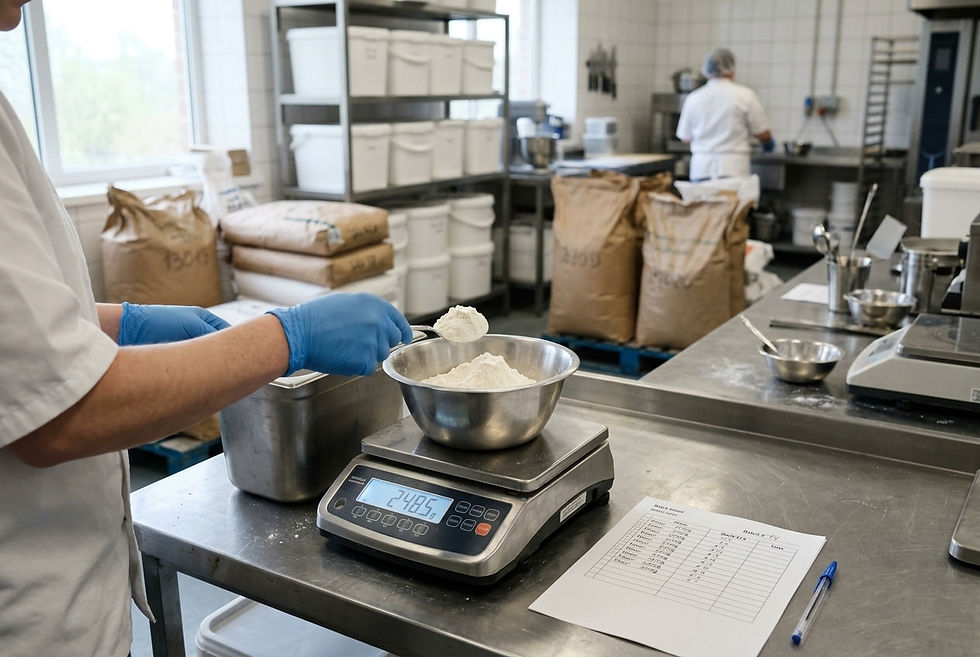
Home and lab recipes often use cups, spoons, and "a handful". Commercial formulas must be written in weight, as a percentage of the total batch, with the order and method of addition recorded. Weighing replaces measuring by volume, because volume changes with temperature and packing, while weight does not. This single step removes a large share of batch-to-batch variation.
Step 3: Understand what each ingredient does
For every ingredient, identify its role: flavor, structure, sweetness, moisture control, preservation, color, emulsification, or bulk. Ingredients usually do more than one job. Knowing the role tells you what you can safely reduce, replace, or remove, and what will break the product if you touch it. A formula you cannot explain ingredient by ingredient cannot be optimized reliably.
Step 4: Test changes with designed experiments
Changing one ingredient at a time is slow and misses interactions, such as salt affecting texture or acidity affecting color. Use a structured experimental design to vary several factors together in a planned set of trials, then measure the results: viscosity, pH, water activity, color, texture, yield, and sensory scores. This finds the best combination in fewer batches and shows how sensitive the product is to small changes.
Step 5: Fit the formula to your process and equipment
A recipe must match the machines that will make it. Check how the product behaves under the actual mixer speed, shear, heating profile, hold time, homogenizer, filler, and cooling method. For example, a sauce that thickens perfectly in a lab pot may become too thick to fill, or break under high shear, on an industrial line. Adjust both formula and process together, and define the critical process parameters, such as temperature, time, pH, and fill weight, that must be controlled every batch.
Step 6: Optimize cost without losing what customers love
Cost optimization is not about cheaper ingredients. It is about cost in use: price per kilogram multiplied by the amount needed and adjusted for yield loss. Look at the biggest cost drivers first, usually one or two ingredients and the packaging. Options include adjusting ingredient levels within validated limits, improving process yield to cut waste, and changing pack sizes. Always re-test taste, texture, and shelf life after any cost change, because a saving that damages the product costs more in the end.
Step 7: Build ingredient flexibility for Lebanon's supply chain
This step separates a fragile formula from a resilient one. For each critical ingredient, write a specification (the measurable properties it must meet, not just a brand name), qualify at least one alternative supplier, and test the product with the alternative so you know it still works. Where possible, set acceptable ranges for natural ingredients that vary by season or origin, and adjust the recipe to the incoming lot rather than hoping every lot behaves the same. Keep safety stock of ingredients with long import lead times.
Step 8: Validate stability and shelf life
Make sure the optimized formula remains safe and stable for its full shelf life. Key factors include pH, water activity, preservation system, heat treatment, and the interaction between the product and its packaging. Run shelf-life studies under realistic storage conditions, including warm storage, which is relevant in Lebanese distribution. A formula is only optimized if it is still good on the day the customer opens it.
Step 9: Confirm with sensory and consumer testing
Instruments can show the product is consistent, but only people can say it tastes right. Compare the optimized version against the original lab version and against competing products, using trained panels or a small group of target consumers. Confirm that cost and process changes have not shifted taste, texture, or appearance in ways customers will notice.
Step 10: Document the final formula and the controls
Write everything down: the master formula, ingredient specifications, process instructions, critical control points, quality checks, and acceptance limits. This documentation lets anyone on your team, or a co-packer, reproduce the product exactly, and it forms the base for your food safety system, HACCP plan, and any future certification.
Step 11: Confirm in pilot batches
Finish by running pilot batches on production-scale or near-production-scale equipment. This confirms that the optimized formula performs as expected outside the lab, and gives you real data on yield, cost, and consistency before you commit to a full production run. If you are planning the full journey from idea to launch, read our guide on how to scale food production in Lebanon.
Common formulation mistakes to avoid
Keeping lab measurements (cups and spoons) instead of a weight-based master formula
Reformulating without a clear brief, target cost, or shelf-life goal
Changing several things at once without recording or measuring the effects
Depending on a single supplier or a single brand for a critical ingredient
Cutting cost without re-testing taste, texture, and shelf life
Ignoring how the formula behaves on the real production equipment
Skipping documentation, so the product cannot be reproduced by another team or co-packer
Frequently asked questions
What does it mean to optimize a food formulation?
It means improving a recipe so it meets targets for taste, safety, stability, cost, and manufacturability at the same time, and performs consistently at commercial scale rather than only in the lab.
How do I reduce the cost of a food formulation without losing quality?
Start with the largest cost drivers and look at cost in use, which includes yield loss, not just price per kilogram. Test ingredient adjustments within validated limits, improve process yield, and always re-check taste, texture, and shelf life after each change.
How do I scale a recipe from a small batch to industrial production?
Convert it to a weight-based master formula, understand each ingredient's role, adjust it for your equipment and process, then confirm it in pilot batches. Do not simply multiply quantities, because mixing, heating, and cooling behave differently at larger volumes.
Why does my product change when I make larger batches?
Larger volumes mix, heat, and cool differently, and small ingredient variations become more visible. The formula and process usually both need adjusting, and the critical parameters must be defined and controlled.
How do I deal with ingredient shortages or price changes in Lebanon?
Write ingredient specifications, qualify alternative suppliers in advance, test the formula with approved alternatives, and hold safety stock of critical imported ingredients. A formula designed with flexibility can absorb supply changes without changing the final product.
Should I hire a food technologist to optimize my formulation?
If your product needs to be shelf-stable, safe at scale, or ready for retail or export, yes. A specialist shortens the development time, avoids costly production mistakes, and builds the documentation that buyers and regulators expect.
How Umami Plus can help
Umami Plus helps food businesses optimize food formulations for commercial production, from the first prototype to a documented, factory-ready formula. With more than 25 years of food R&D experience across Lebanon, Africa, and the MENA region, the team has worked on projects such as tahini safety optimization, ready-to-eat Lebanese dishes, instant functional beverages, and the commissioning of food manufacturing facilities.
Have a formulation that needs to scale? Start a project with Umami Plus.
Comments